
Competition
Di Bari and Bueno Finish Osaka Bronze with a Straight-Sets Final Win
Mattia Di Bari and Toni Bueno won the men’s title at the FIP Bronze High Velocity Osaka, completing their tournament with a 6–4, 6–4 final victory over Medina Murphy and Alberto Garcia. In the women’s competition, Louise Bahurel…
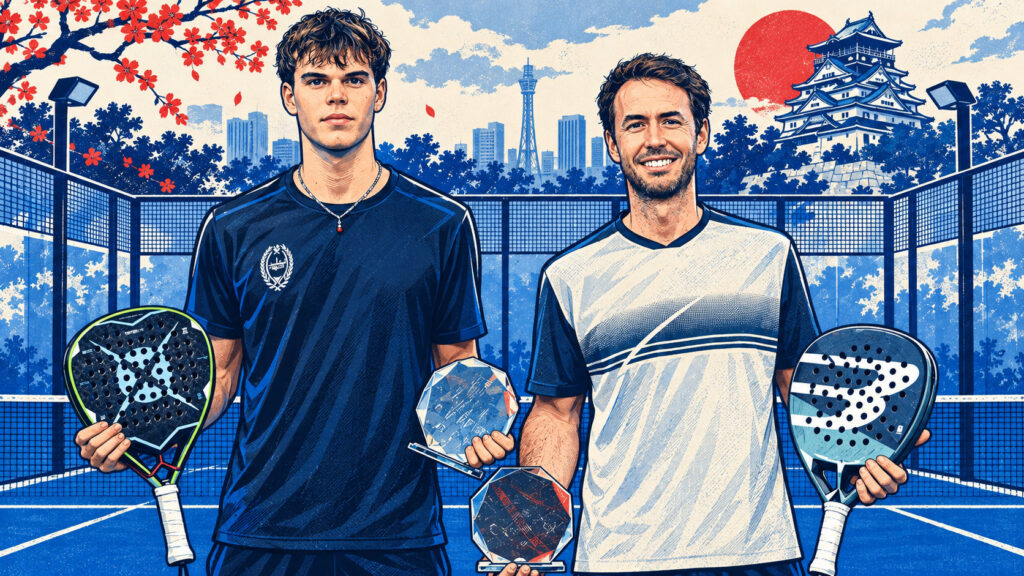
Mattia Di Bari and Toni Bueno won the men’s title at the FIP Bronze High Velocity Osaka, completing their tournament with a 6–4, 6–4 final victory over Medina Murphy and Alberto Garcia. In the women’s competition, Louise Bahurel and Ivet Val also finished in straight sets to secure the trophy.
The June 2026 event was staged within the 16–21 June calendar window. Its closing results added another Japanese stop to the season’s regional record, with both champions having to earn their place in the final through a different type of semifinal challenge.
For Di Bari and Bueno, the demanding encounter came against Tonet Sans and Gustavo Nunes. They lost the opening set before recovering to win 6–7, 7–5, 7–6. Bahurel and Val, meanwhile, completed their women’s campaign without dropping a set, defeating Carla Fernandez and Nerea Guerra 6–4, 6–0 in the final.
Surviving the match before the final
The men’s semifinal is central to understanding the title run. Three close sets meant there was no comfortable route into the trophy match. Losing an opening tiebreak left Di Bari and Bueno with the same immediate task that confronts any pair a set down: remain competitive long enough to change the situation.
Their recovery establishes the result, although the score cannot reconstruct the conversations or tactical changes behind it. What it does show is a partnership that kept the match alive through another tight set and then won the deciding tiebreak.
That kind of encounter can be the hardest part of a tournament even when it does not appear in the headline. A final supplies the trophy photograph, but an earlier match may demand more time, more uncertainty and a greater capacity to restart after disappointment. The winning run only exists because that earlier obstacle was cleared.
A different task on finals day
The 6–4, 6–4 final gave the men’s champions a more direct finish. Both sets remained competitive, but neither reached the tiebreak territory of the semifinal. Di Bari and Bueno converted their place in the last match into the title rather than allowing the previous round to become the high point of their week.
For amateur pairs, this is a useful way to think about tournament progression. Beating a strong opponent can feel like a final in itself. The next encounter still begins at zero, with another pair trying to expose different weaknesses. Emotional recovery matters alongside the physical preparation for going back on court.
It also changes how a run should be judged. A partnership capable of winning in several different scoreline patterns has shown more than one response to pressure. Osaka supplied both a comeback through a deciding tiebreak and a final completed without requiring a third set.
The women’s champions set their own pace
Bahurel and Val’s title deserves a separate reading. Their unbeaten set record and decisive second set in the final describe a tournament in which opponents were unable to push them into a deciding contest. The result stands alongside the men’s comeback story without needing to imitate its drama.
Fernandez and Guerra’s place in the final also matters for followers tracking familiar names across the Asian calendar. A regional season becomes easier to understand when supporters connect appearances and partnerships between events, rather than starting from a blank page each weekend.
For Thailand’s growing audience, Osaka offered an accessible set of sporting reference points: a men’s pair surviving an exceptionally close semifinal, two straight-set final victories and another meeting of players competing around the region. Those are the details that make the tournament useful to follow beyond its host city.
Di Bari and Bueno left Japan with the men’s trophy, while Bahurel and Val supplied the women’s winning partnership. Their paths underline two distinct competitive strengths: finding a way through the tightest match of a run, and maintaining enough control to avoid that situation altogether.
Reader comments
Share your view. Your email address will not be published.
Leave a Reply