
Clubs & Community
Six Communities, One Scoreboard: Bangkok’s Community Cup Returns
The second Community Cup brings Iron, Bronze, Silver and Gold players into the same team contest at Pad Thai Padel, with captains, squad selections and a shared result to play for.
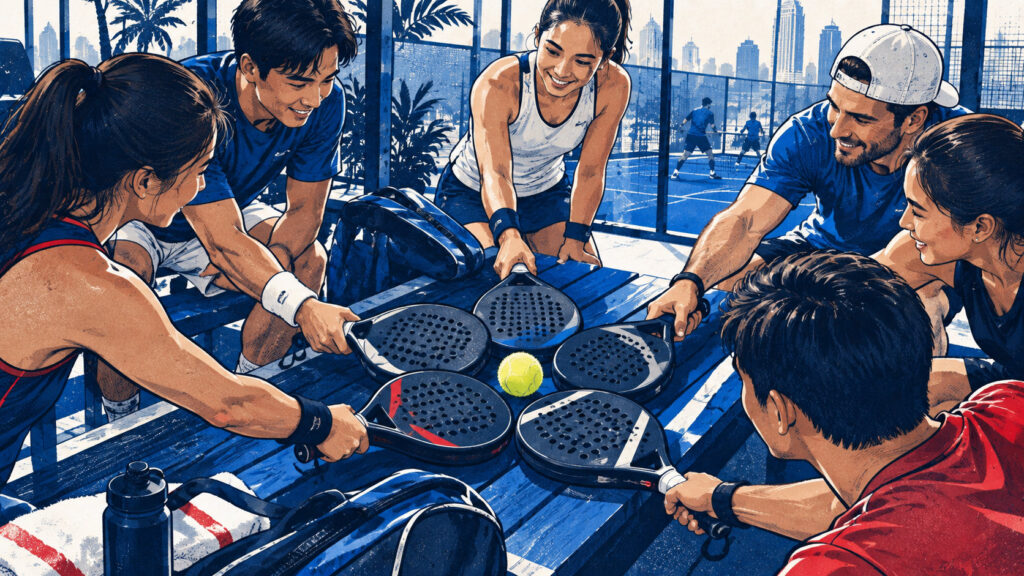
Bangkok’s second Community Cup is scheduled for Sunday 13 September at Pad Thai Padel Rama 4, with six communities competing across the club’s playing levels. The attraction is easy to understand: your result belongs to the people around you as well as the partner beside you. An ordinary weekend match becomes one part of a much bigger team effort.
The published programme runs from 9am to 5pm and lists an entry fee of THB1,500 per person. The Padel Society and Pad Thai Padel organise the competition, with Open Rally as a partner. The event gives groups that normally meet through social sessions and app communities an opportunity to compete under a shared identity.
There is room for ambition at every level. Iron, Bronze, Silver and Gold each have a place in the format, with men’s, women’s and mixed matches within the ties. Each community needs at least two men and two women per level. The structure makes the depth of a group matter alongside the ability of its strongest pair.
The interesting decisions happen before the match
The club’s guide describes a player pool, two captains for each community, and a squad selection process. One female captain and one male captain select the team, followed by a 72-hour window for exchanges involving players of the same level. That introduces a little of the anticipation normally associated with larger team sports into a club padel event.
For a captain, the sporting question is more interesting than simply collecting the hardest hitters. A player who communicates well can make a partner more comfortable. Someone dependable in mixed doubles may be especially useful when the team has several different matches to cover. Availability, compatibility and the willingness to accept a particular role can all influence how a squad works.
Those are general considerations rather than predictions about any of the six teams. The appeal of the selection format is that it asks people to think about padel collectively. A group needs combinations that function on court, not just a list of individuals who look impressive in isolation.
It also gives players a different reason to pay attention to matches outside their own level. A Gold player can have a direct interest in how the Iron squad performs. A beginner can support a more experienced teammate while knowing that their own appearance contributes to the same community’s day.
A place for the player still learning
That shared interest is one of the most promising parts of the concept. Club competitions can sometimes feel like an activity happening just beyond a newer player’s reach. The familiar faces are there, but the draw belongs to people who have been playing longer and understand all the unwritten routines.
A competition organised around several levels offers a more approachable entrance. It does not remove the pressure of keeping score or playing in front of others. It gives that pressure a more suitable setting, with opponents selected through the same level structure and teammates who have a reason to offer support.
The first difficult service game can feel very different when someone nearby is encouraging you rather than waiting impatiently for a better match to begin. That is where community sport becomes tangible. The welcome is expressed through behaviour at the court, especially when a player is nervous or makes a mistake they have not yet learned to laugh about.
More experienced participants have something to gain from that environment too. Helping a teammate settle can make a player think more clearly about communication, patience and the difference between a useful instruction and a running commentary. Those skills travel back into an ordinary doubles partnership.
Familiar friends, unfamiliar combinations
The possibility of being selected into a new squad adds another layer. Many regular players spend most of their court time with a small circle, developing habits that work because everyone already knows what to expect. A team event can interrupt that comfortable pattern in a productive way.
A new pairing has to agree on practical details quickly. Who takes the ball through the middle? What happens when both players retreat? How should one partner signal that they want to change the pace? None of those conversations needs to be complicated, but avoiding them can make a simple situation unnecessarily difficult.
For spectators, those developing partnerships are part of the interest. The match is not only a comparison of individual shots. It is a chance to see whether two people can become more effective together as the contest develops, and whether the support around them helps them recover when the score moves against them.
The result extends beyond one pair
The Cup’s team structure gives Bangkok’s social padel groups a sporting appointment around which to gather. It adds a scoreboard to relationships that may have started through an Americano, a shared court booking or a conversation after a lesson.
That is a strong reason to follow the second edition. Every division has a role, both men and women are built into the squad requirements, and the result asks communities to contribute across their depth. On 13 September, the most compelling contest may be how well six groups turn familiar enthusiasm into a team that plays for one another.
Reader comments
Share your view. Your email address will not be published.
Leave a Reply