
Competition
Mixed Doubles Gets a Cash Prize as PPS Returns to Padel Bay
The September PPS APPT Challenger adds cash prizes to its Mixed Open draw, with a partnership rule designed to shape the field and registration closing on 20 September.

Mixed doubles has an extra reason to attract attention when Phuket Padel Series returns at Padel Bay from 25 to 27 September. The PPS APPT Challenger #18 will offer cash prizes in its Mixed Open category, giving that part of the programme a defined financial reward alongside the opportunity to compete for a title.
The published prize allocation is $300 for the winning mixed pair and $150 for the runners-up. APPT lists the mixed allocation within a $3,700 professional prize pool covering the men’s, women’s and mixed competitions. The new detail makes mixed doubles a more prominent part of the September return.
Behind the PPS programme are Mika, from Sweden, and Jose, from Spain.
There is also a condition that prospective partners need to understand. A man ranked inside the APPT top 30 cannot team up with a woman inside the APPT top 20. The organiser uses the rankings at the time of registration. The restriction concerns that combination of two highly ranked players, rather than excluding either group from the event altogether.
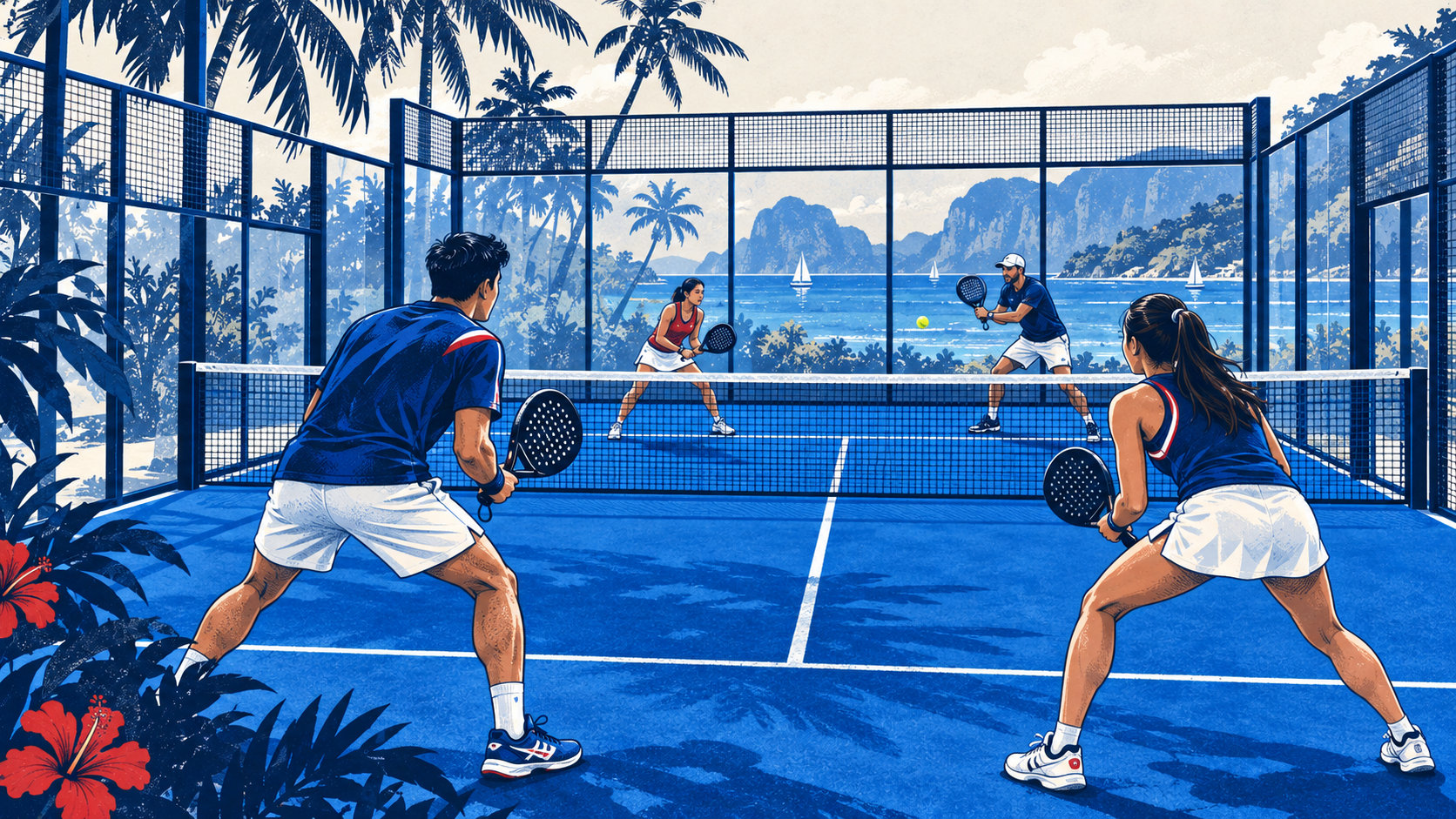
The choice of partner becomes part of the story
That rule gives the Mixed Open an interesting sporting question before the draw is made. A pair has to satisfy the entry conditions and still find a way to make two individual games work together. Familiarity may help, but the strongest partnership is not always the one with the most obvious names.
Mixed doubles rewards the same shared understanding that makes any doubles pair effective. Both players need to know how they will defend space, move forward and respond when the opponents repeatedly choose one direction. A team can become difficult to beat through consistency and coordination, even without winning every exchange through raw power.
The important conversation is therefore practical. Which side does each player prefer? Who takes responsibility for a ball down the middle? What should happen when an attacking opportunity disappears and the pair has to defend again? Answering those questions is more useful than assuming one partner can solve every difficult situation.
For spectators, the appeal lies in seeing those combinations tested. An established player alongside someone with a different competitive background can create an unfamiliar partnership, with strengths that only become clear once the match begins. The entry rule helps make the composition of the field part of the interest.
The autumn return has a clear setting
The September stop follows the summer pause announced by PPS in June. In that announcement, the series identified the rainy low-season period as the reason for a break and pointed towards the Padel Bay weekend as its return. The new event therefore resumes a continuing local season rather than starting a competition from scratch.
Padel Bay Indoor Club in the Cherng Talay area is the named venue. APPT’s published programme places professional qualifying, professional mixed play and amateur categories on Friday, followed by further competition on Saturday and the closing rounds on Sunday. Individual match times will depend on the final schedule.
For players entering more than one category, the practical consequence is to think about the whole weekend. A second entry creates another opportunity to play, but it can also mean a more demanding sequence of matches. The useful preparation is the kind that leaves the partnership ready to compete again, rather than treating the opening appearance as its only task.
A wider programme around the mixed draw
PPS lists men’s and women’s Open competition alongside several amateur tiers, with mixed categories available at Open and amateur levels. That range gives established competitors and developing pairs different places within the same event.
The early entry list already contains combinations with a Thai connection, including Arisa Promin and Nita Nooring in the women’s amateur programme, and Mario Wongsuwan with Eric Foerster in the men’s Diamond category. Those are listed entries, with the final draw still to establish their opponents and route through the tournament.
That broader participation matters to the character of a PPS weekend. A headline category can attract attention, but the amateur matches bring many of the regular players whose rivalries and partnerships give the local series continuity. Their competition has its own stakes, even where the prize is not a cash payment.
A close match against a familiar opponent can be the encounter a player remembers longest. So can a first tournament with a new partner, or the moment a training improvement begins to work under pressure. Those experiences sit alongside the leading finals rather than waiting for permission to matter.
The next deadline is 20 September
Registration for the Padel Bay event is through APPT and is scheduled to close on 20 September. For the Mixed Open, checking the partnership restriction is an essential part of choosing a teammate before completing that entry.
The sporting promise of the new cash allocation is straightforward: mixed doubles receives a more visible place in the tournament’s reward structure. Whether it produces a surprise partnership, a particularly close final or a new rivalry will be decided on court. For now, PPS has given its September return a specific talking point and mixed pairs a clear reason to start planning together.
Reader comments
Share your view. Your email address will not be published.
Leave a Reply