
Practical guide
Padel vs Tennis: What Changes When You Step Inside the Glass?
Compare padel with tennis, then adapt your preparation, wall play and movement as a pair. A five-step transition plan explains what transfers and what to practise in your first session.
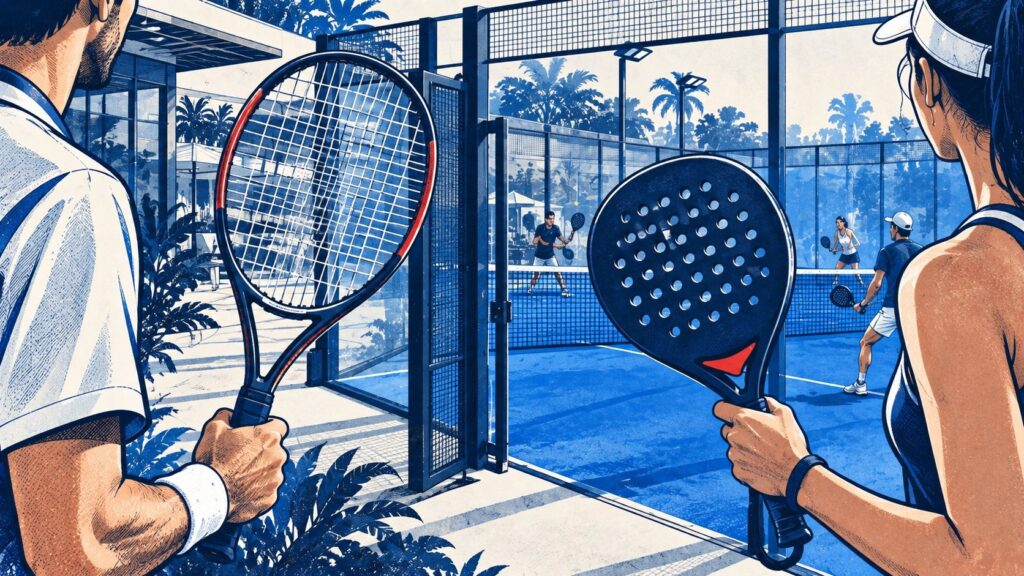
Moving from tennis to padel means adapting to a smaller enclosed court, a bounced underhand serve and a ball that can come back from the wall. Keep your timing and racket awareness, then shorten your preparation and learn to move with a partner rather than covering every space alone.
This guide is for tennis players trying padel and for newcomers deciding what to expect from the two sports. Familiar skills help, but the first session is more useful when you deliberately practise the situations tennis has not taught you.
The useful transfer: footwork, anticipation and controlled contact. The new homework: the glass, service sequence, compact preparation and shared decisions through the middle.
Start with the five-step transition plan if you already have a first padel session booked.
Padel and tennis: the main differences
Padel’s regulation doubles court is 20 by 10 metres; a regulation tennis doubles court is 23.77 by 10.97 metres. Padel uses a solid perforated racket and its own ball specifications. Tennis uses a strung racket, and the two types of ball should not be treated as interchangeable equipment.
The padel enclosure can extend a rally after a legal floor bounce. In tennis, the surrounding fence is not a rebound surface you use to keep a normal point alive. In padel, judging the ball’s next position after the wall becomes part of routine preparation.
For a first introduction to the court and equipment, read what padel involves before choosing a session.
| Feature | Padel | Tennis |
|---|---|---|
| Usual game considered here | Doubles on an enclosed court | Singles or doubles |
| Serve | Bounced, struck at waist height or below | Usually overhead; an underarm serve is also permitted |
| Racket | Solid, perforated hitting surface | Strung hitting surface |
| Walls | Can be part of a legal rally | Not used as a normal rebound surface |
| Preparation | Adapt to rebounds and close exchanges | Adapt to the tennis court and incoming ball |
What changes at the start of the point?
In padel, the server bounces the ball and strikes it at waist height or below into the opposite service box. The receiver lets the serve bounce. You still need placement and preparation, but the familiar tennis contest built around a high overhead serve is no longer the starting pattern.
The glass and fence have different consequences after a service bounce. Do not improvise a rule from how a tennis serve would behave. A quick demonstration before the game helps you recognise the correct sequence.
Our first-match rules guide covers serving, wall contact and the scoring format to agree.
Adapt from tennis to padel in five steps
1. Start with manageable preparation
Use a compact preparation for comfortable rallies and prepare the racket early. A large backswing may leave you late when the ball rebounds towards you or when a net exchange becomes quick.
Practise at a pace where you can make contact without accelerating at the last moment. Keep the useful tennis habits of watching the ball and adjusting your feet, while allowing the enclosed court to change the size of the swing you need.
2. Learn a rebound before trying to attack it
Ask for predictable balls to the back wall. Watch the floor bounce, turn and follow the rebound rather than rushing to hit everything immediately. Compare playing before the wall and waiting for it when the incoming ball allows.
Leave yourself room. Our beginner-mistakes guide explains why standing against the glass and changing direction late can make straightforward balls feel difficult.
3. Treat court position as a pair’s decision
Agree who starts on each side and how you will call a central ball. When moving forward or recovering, check where your partner is. One player charging the net while the other remains deep can leave the pair with a difficult gap to defend.
A short conversation between points is more useful than two players interpreting the middle differently during the next rally. Your doubles experience helps here, but the wall and court proportions create new situations to practise together.
4. Test the padel equipment on ordinary shots
Borrow a suitable racket if possible and compare how easily you can prepare it for a return, block or ball after the glass. You do not need to choose a professional model because you already play tennis well.
The complete racket guide explains weight, balance and core feel, with a practical demo sequence before buying.
5. Join a game that fits your padel experience
Tell the organiser both that you play tennis and how much padel you have played. Ask for a session where you can learn the rebounds and positioning without having to pretend those skills are already settled.
A lesson can focus on the situations that remain unfamiliar. A social game can then give you time to repeat them. Progress depends on the decisions and contacts you can manage, rather than on assigning yourself an advanced label on the first evening.
Our guide to finding partners in Thailand helps you describe your experience and confirm a place in a compatible session.
What to practise in the first session
Choose three tasks: make a legal serve and return, play a predictable ball after the back wall, and call the middle early. Use comfortable feeds first, then test the same decisions during ordinary points.
Notice when tennis experience helps and when it encourages you to hurry. You can retain a reliable volley while changing the preparation around it. You can also keep a good competitive instinct while choosing a patient defensive shot.
A useful check: if you are striking the ball cleanly but repeatedly ending up in the wrong place, spend the next practice block on movement and the rebound. Another harder hit is unlikely to answer the positioning question.
Return to the first-session focus when you want a small, repeatable practice brief.
Frequently asked questions
Will tennis experience make padel easy?
It can give you a useful starting point for timing, footwork and racket awareness. It does not automatically teach you the wall rebound, padel’s service conditions or how to position a pair inside the enclosure. Treat those as skills to learn rather than evidence that your tennis technique has failed. A beginner lesson or suitable social game lets you test the familiar skills and work deliberately on the unfamiliar situations.
Can I use my tennis racket and tennis balls?
Use padel equipment for a padel session. The racket is solid and perforated rather than strung, and the ball has padel-specific specifications. Ask the club whether it hires rackets and supplies balls before buying or travelling. Trying an appropriate loan racket also gives you a reference for handling, weight and grip fit. Bringing sports experience is helpful; assuming the equipment transfers unchanged is a less useful shortcut.
Do I have to change every tennis stroke?
No. Start by adapting preparation, spacing and shot selection to the ball you receive. A compact swing can help near the wall and in quick exchanges, while familiar controlled contact remains useful. A coach can identify what needs changing in your particular game. Avoid rebuilding all your strokes after one difficult session: select a recurring situation, practise it deliberately and keep the adjustments that make your decisions more reliable.
Is padel easier physically than tennis?
A smaller court does not tell you how demanding a session will feel. Match pace, playing level, duration, conditions and your own movement all matter. Start with a session suited to your current experience and allow time to get used to changes of direction and the wall. If you are planning repeated games during a trip, leave practical breaks rather than judging the whole schedule from the court dimensions alone.
Your next step
Book a session where you can practise the back-wall rebound and movement with a partner. Bring your tennis skills, tell the organiser what is new to you and give yourself a clear target beyond winning: make the next ball easier to read.
Reader comments
Share your view. Your email address will not be published.
Leave a Reply