
Practical guide
Padel Rules for Your First Match: Serve, Glass and Score
Learn the serve, glass, fence and scoring rules before your first padel match. Five practical steps, clear examples and a checklist explain what to agree before the opening point.
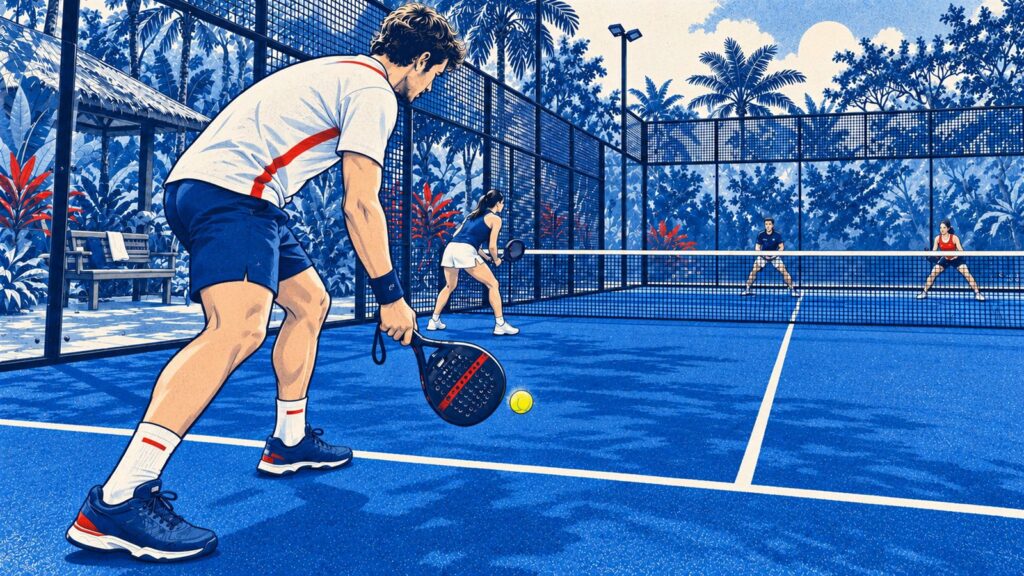
For a first padel match, learn the diagonal underhand serve, the order of the floor and wall bounces, and the scoring format your group is using. Agree those points before you start. Most beginner disputes come from treating a familiar-looking tennis situation as if the same rule must apply.
This guide covers ordinary doubles play and the situations you are likely to meet in an introductory game. If you are entering an organised competition, its published format and the referee’s instructions also matter. A social group’s shortened game is not automatically a tournament’s scoring system.
Remember the sequence: on a serve, bounce the ball before striking it; on a return, let the serve bounce; during a rally, send the ball onto the opponents’ court before it touches their wall or fence.
Use the five-step rules check below to prepare for a game without memorising every exceptional situation.
Learn the essential rules in five steps
1. Start behind the service line
Stand in the correct serving area behind the service line, between the extension of the centre line and the side of the court. Bounce the ball there and strike it at waist height or below. Keep at least one foot on the ground when serving and do not step onto the service line before contact.
Serve diagonally into the opposite service box. Alternate the right and left serving boxes as the game progresses. You have two attempts for each point; two faults lose the point.
If the equipment and court are still unfamiliar, our first-game guide explains what to arrange before arriving.
2. Check where the serve lands and what it touches next
The serve must land in the correct service box; its boundary lines count as in. The receiver must let it bounce before returning. A serve that reaches the glass after a correct bounce can be valid, but hitting the metal fence before the second floor bounce makes it a fault.
A serve that touches the net may need to be replayed when the other conditions for a let are met. Touching the net does not rescue a serve that lands outside the correct box or follows a fault sequence. Ask the organiser to demonstrate a service let if it is new to your group.
The bounced, low serve changes the start of the point for tennis players. Our padel-versus-tennis comparison explains the practical differences.
3. Recognise a legal rally ball
After the serve has been returned, you may volley or play the ball after its first floor bounce. If it bounces on your side and then rebounds from your wall, you can still return it before a second floor bounce.
Your return must reach the opponents’ side legally. A ball that lands there and then hits their glass or fence can remain in play. A ball sent directly into their wall or fence without landing on their court first loses the point.
Giving yourself room to judge that rebound is a playing skill as well as a rules question. Our beginner-mistakes guide offers practical adjustments for spacing and preparation.
4. Know what ends the point
Among the common ways to lose a point are allowing two floor bounces, sending the ball out incorrectly, touching the net while the ball is in play or having the ball strike your body. Your racket must make the permitted return; catching a difficult ball is not another shot option.
Using your own glass to send a return across the net can be legal. Hitting your own floor or metal fence before the ball crosses is not. Both partners cannot strike the ball successively as a team return.
Use the racket’s wrist cord during play and check its attachment. Our racket-selection guide covers equipment fit and checks for new or used models.
5. Agree the score and the deciding-point format
Ordinary games progress through 15, 30 and 40. A standard set is usually won at six games with a two-game margin, with a tie-break at 6–6 when that format applies. A standard tie-break is played to seven points with a two-point margin.
At 40–40, establish whether you are using advantage, golden point or star point. Advantage requires two successive points from deuce. Golden point decides the game on one point. Star point allows two advantage cycles before a deciding point at the third deuce.
Competition formats can use different match lengths or a match tie-break. Our first-tournament checklist explains what to confirm in the organiser’s entry information.
Examples that settle the common questions
Serve, correct bounce, back glass: it can be a valid serve. The receiver still has to make a legal return before the next floor bounce.
Serve, correct bounce, side fence before another floor bounce: it is a service fault. The service rules distinguish the fence from the glass.
Rally ball, bounce on your court, back glass: the ball can still be returned. The glass has not ended the point by itself.
Shot straight into the opponents’ glass: you lose the point because the ball did not first land on their court. Power does not change the order required.
When the group is unsure: stop between points, describe the actual sequence and check the rule. “It hit the glass” is incomplete information; which side, and before or after which bounce?
Use the before-the-first-serve checklist to keep score and service order from becoming a mid-match negotiation.
Before the first serve
- Agree the match length, set format and deuce system.
- Establish the serving and receiving order.
- Confirm whether any shortened social format is being used.
- Check your wrist cord and remove loose balls from the playing area.
- If playing a tournament, know where to ask for a rules decision.
Frequently asked questions
Can I volley a serve in padel?
No. The receiver must allow the serve to bounce in the service box before returning it. Volleys are available during the rally once the serve has been returned, but that does not remove the receiving requirement. If you are coming from tennis, make this part of the warm-up: let a gentle serve land, turn early and return it without rushing forward to intercept the ball in the air.
Can I hit the ball off my own glass?
A return played via your own wall can be legal if it then reaches the opponents’ court correctly. This is different from striking your own metal fence, which is not an allowed route for your return. The ball also cannot bounce on your own floor after you hit it and before crossing. Begin with the simpler rebound situation, where the incoming ball bounces and reaches the wall before you make contact.
Does the ball touching a line mean it is out?
A serve landing on the boundary of the correct service box is in, although what it touches afterwards can still make it a fault. Do not decide solely from a line call whether the whole service sequence was legal. During ordinary rallies, judge whether the ball landed on the opponents’ playing surface before reaching their enclosure. If you are unsure about a close call, follow the agreed social procedure or the competition official’s decision.
Which scoring system should beginners use?
Choose a format everyone understands and state it before starting. For an introductory social session, your organiser may use shorter games to keep rotations manageable. If you want to practise standard match scoring, agree the set length, tie-break arrangements and deuce system. In a tournament, use the published competition format. The purpose of agreeing early is to avoid discovering at 40–40 that the two pairs expected different rules.
Put the rules into practice
Ask an experienced player to demonstrate one valid serve, one service fault involving the fence and one ball played after the back glass. Then play a short game with the agreed score. A few clear examples give your first rallies a much firmer starting point.
Reader comments
Share your view. Your email address will not be published.
Leave a Reply