
Gear explained
How to Choose a Padel Racket: A Complete Guide for Your Game
Choose a padel racket by your experience, playing priorities, weight, feel and budget. A complete guide to specifications, junior models, on-court testing and buying used in Thailand.
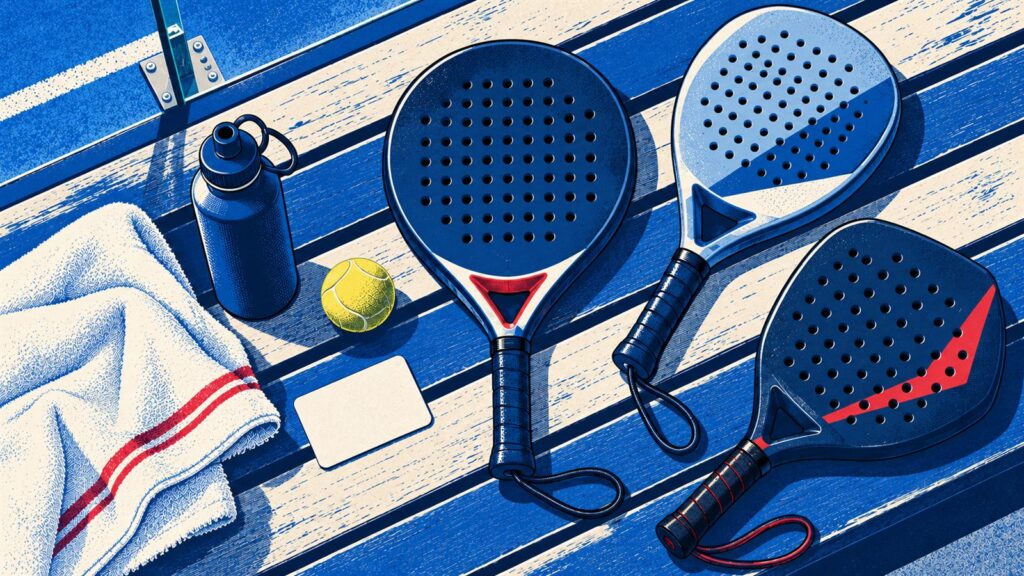
Choose a padel racket by starting with the player: your current experience, the shots you want to make easier, the weight you can handle and the feel you prefer. Then set a budget and test a small shortlist. A professional’s signature can wait until those questions have answers.
This guide follows the six decisions in the Pumpui Padel racket finder and explains how to turn them into a purchase. It works for a first racket, a replacement or a junior player’s next model. The aim is to find something you can use comfortably through an ordinary match, including the points when you are late to the ball.
Your buying brief: player and experience, main priority, manageable weight and balance, preferred feel and a total spending limit. Use those answers to choose a few models, then inspect and test the actual racket.
A useful purchase should make the shots you already play easier to repeat. Keep your current racket as a reference if you have one, and identify the particular change you want before comparing model names.
Start with the six racket decisions below, then use the practical test before choosing.
What is a padel racket?
A padel racket has a solid, perforated hitting surface, a supporting frame and an internal core. Its dimensions, construction and weight distribution affect the complete object you swing; no single specification describes all of those properties.
Choose for the player’s hand, preparation and preferred response. A racket can be suitable for controlled defence, quick exchanges or attacking shots without its material label deciding whether it suits every person in that group.
If you are arranging your first session as well as your first purchase, our first-game guide explains what to confirm with the club.
1. Is the racket for an adult or a junior?
Start here, before comparing brands. A junior racket should suit the child’s hand, strength and ability to prepare the racket repeatedly. Weight, dimensions and handle size matter together; a light adult racket is not automatically the same proposition as a junior model.
Let the player hold it, turn the face and make a few controlled swings. Can they prepare for a volley without dragging the head behind them? Can they hold the handle securely without stretching around it? If possible, ask their coach to check the fit during a lesson.
For adults, choose by fit and handling rather than the gender printed on the product page. A lighter model may suit any player who values quick preparation. An adult with a smaller hand still needs a comfortable handle, and extra overgrips change both its size and the racket’s weight.
2. Choose your current experience
Getting started: you are learning the shots, finding your position and building reliable rallies. Prioritise manageable handling, predictable contact and enough forgiveness when you miss the centre. There is little value in extra attacking potential if you struggle to prepare the racket for a return.
Already playing: you play regularly and know the basic shots. Use your current racket as a reference. Identify one thing you want to improve: quicker preparation, more predictable blocks, a different feel or stronger attacking shots. Keep the features that already work for you.
Tennis, squash and badminton experience can help, but choose according to your padel game now. Moving to more demanding equipment is optional. An experienced player can prefer a forgiving round racket for entirely sensible reasons.
When the recurring problem is position or a late decision, use our beginner-mistakes guide to separate a practice need from an equipment need.
3. Decide what matters most in your game
Control: you want to place the ball, defend comfortably and build points with fewer loose shots. Look first at models described as control-oriented, then check their balance and actual weight. Control means a response you can repeat, rather than a promise that the racket will aim for you.
A bit of everything: you want a useful mix of defence, volleys and attacking shots. Teardrop and hybrid designs are worth comparing, alongside round models with a more versatile response. Avoid making one spectacular smash the deciding factor.
An attacking profile: you want to prioritise aggressive volleys and overheads. A more head-heavy racket may be worth trying if you can still prepare it early and handle defensive balls. Check the cost in manoeuvrability during quick exchanges.
Not sure yet: leave the shape options open. Borrow or demo contrasting rackets and notice which makes routine shots easier. Your preferred side of the court is useful context, but it does not prescribe a particular shape.
Round, teardrop, hybrid or diamond?
- Round: commonly offers a more central sweet spot and a control-oriented design. It is a sensible starting point for beginners and remains a valid choice for experienced players.
- Teardrop: commonly aims for a blend of control and attacking potential. It covers a broad range of models, so check the individual specification.
- Hybrid: describes designs between familiar shapes. Treat it as a broad label and investigate weight, balance and feel.
- Diamond: commonly has a higher sweet spot and a more attacking design, often with a higher balance. It may ask more of your preparation and contact accuracy.
These are design tendencies. Shape alone cannot tell you how demanding a racket will feel.
Once you have a few candidates, jump to the on-court comparison to test handling on your normal shots.
4. Find a weight you can handle
Pumpui uses three practical filters: lighter, up to 355 g; midweight, 356–370 g; and heavier, over 370 g. These are browsing categories, rather than universal recommendations. If you have no reference point, compare weights instead of choosing a number because it sounds appropriate for your level.
A published range is not the weight of every racket in that model. For example, a hypothetical 360–375 g specification spans two of those filters. Ask the seller to weigh the individual racket and explain whether that figure includes its current grips, protector and strap.
Overgrips and protectors add weight. As a simple example, a racket weighing 360 g with 10 g of added accessories weighs 370 g ready to play. Where the accessories sit also matters: adding a protector near the top changes the distribution differently from adding an overgrip at the handle.
Balance explains why equal weights can feel different
Balance describes where the racket’s centre of mass sits. A lower balance places it nearer the handle; a higher balance places it nearer the head. Two rackets with the same scale weight can therefore feel different when you prepare a volley or change direction.
Check weight and balance together. A head-heavy model may feel harder to move quickly than another model with the same grams. If a specification gives a balance measurement, confirm the units and where it was measured from before comparing it with another listing.
Swingweight describes resistance to rotation during a swing. It is useful when measured on a comparable basis, but it cannot be read directly from weight alone. On court, the practical question is whether you can prepare, strike and recover without fighting the racket.
5. Choose the feel you want to try
The core is the foam inside the racket. A softer core generally gives a more cushioned sensation; a firmer core tends to feel more solid and direct. Neither description is a quality grade, and the face, construction and playing conditions also influence the result.
If you have never tried both, keep this choice open. Compare a softer and a firmer model using gentle blocks, controlled volleys and ordinary groundstrokes. Notice how much swing you need, whether the ball response feels predictable and whether the racket remains comfortable as the session goes on.
Soft, medium and hard are not a standardised scale across brands. EVA names and proprietary core labels need their accompanying descriptions. A multi-layer core also cannot be reduced neatly to one adjective.
If your present racket feels uncomfortable, include weight, balance and grip fit in the comparison. A softer core or an anti-vibration feature is not a guarantee of comfort. Stop a trial that causes pain rather than trying to justify the purchase.
6. Set a budget in Thai baht
The selector offers spending limits of ฿3,000, ฿5,000 and ฿8,000, or no maximum. These are your chosen ceilings, not claims about what particular rackets currently cost. Its price filter applies to advertised offers and can include new and used rackets.
Keep room for delivery, a suitable grip setup and any accessories you actually need. Compare the total you will pay, the condition of the individual racket and the seller’s terms. A lower-priced previous edition may be worth considering, provided it meets your brief.
Distinguish a model recommendation from an offer. A racket can match your preferences while having no matching listing at your budget. No displayed price means you need to check availability; it does not establish that the racket is available cheaply somewhere else.
A higher spending limit opens more offers. It does not establish that a heavier, harder or more expensive racket will suit you better.
If you need a suitable session for a demo or a first game, our partner-finding guide explains how to ask an organiser for a compatible place.
How to read the rest of a racket specification
Separate the frame, face and core
The frame supports the racket, the face is its hitting surface, and the core sits inside. A carbon frame can be combined with a fibreglass face. Read each line separately rather than assuming that “carbon” describes the whole racket.
Fibreglass faces are often used for a more flexible response; carbon faces come in many constructions and feels. Neither material name settles comfort, durability or suitability on its own. Look at the exact model and version.
What do 3K, 12K and 18K mean?
In a carbon-fibre specification, K refers to thousands of filaments in a bundle: 3K means 3,000, for example. It is not a power score or a quality ranking. The fibre, weave, layers, resin and core all contribute to how the finished racket behaves.
Do not assume that 18K must be harder, more powerful or better than 3K. Also check the material beside the number: a listing that says “3K fibreglass” is describing fibreglass, rather than a carbon face.
Thickness, texture and product scores
Many adult rackets list a 38 mm profile, the maximum head thickness in the rules. That figure alone tells you little about which model will suit your game. Junior models can use different dimensions, so compare their full specifications.
A rough or textured face is one design feature to consider if you use spin. It does not remove the need for suitable contact and technique. When buying used, inspect the surface rather than relying on photographs from when the racket was new.
A brand’s power or control score explains how that brand presents the product. Unless the method is shared and comparable, an 8/10 from one company cannot be treated as equivalent to an 8/10 from another. Check the model year and suffix too: Light, Comfort, Pro, Hard and Soft can identify materially different versions.
Turn your answers into a shortlist
Use these profiles as starting briefs. Each describes what to investigate, rather than a compulsory specification or a claim that every player in the group needs the same racket.
| Your priority | Start by comparing | Check on court |
|---|---|---|
| Learning the game | Forgiving round models, manageable weight and lower balance | Preparation, routine returns and off-centre contact |
| Control and defence | Round or control-oriented designs with handling you already like | Lobs, blocks and balls after the glass |
| A versatile game | Teardrop, hybrid and versatile round models | Defence and attack during the same session |
| Attacking shots | Attacking teardrop or diamond designs within your handling limits | Overheads, quick volleys and recovery |
| Quick preparation | Lighter and lower-balance options | Fast exchanges and stability on blocks |
| A junior player | Junior models that fit the player’s hand and strength | Comfortable grip and repeated controlled swings |
Choose two or three candidates that meet your main needs. For each, write down the exact edition, listed weight range, balance, core, face material and available offer. An unknown specification is a question for the seller, rather than a blank to fill with an assumption.
Use consistent, legal match situations for the comparison. Our first-match rules guide clarifies the serve and wall sequences if they are still unfamiliar.
A practical on-court test before you buy
Compare candidates in the same session if a club, coach or shop offers demos. Use the same balls and similar grip setups where possible. Alternate rackets instead of giving one all the fresh-arm minutes and testing the other only when tired.
- Return a serve. Check whether you can prepare early and direct an ordinary return without forcing the swing.
- Play a ball after the glass. Notice whether you can lift a controlled defensive shot when the available swing is small.
- Hit a lob. Look for repeatable height and depth rather than one successful attempt.
- Block and volley. Test both gentle contact and a faster exchange. Does the face stay predictable, and can you recover it for the next ball?
- Play controlled overheads. Include the shots you normally use to keep position. Then try attacking shots at an intensity you can control.
- Finish with ordinary points. Check handling again after playing for a while. A racket should remain manageable beyond the warm-up.
Give each candidate a simple note for preparation, consistency, comfort and attacking response. These are your impressions, not laboratory scores. If one racket improves an occasional smash but makes returns and defence less reliable, decide whether that trade-off fits the points you actually play.
Judge the complete trial: preparation, predictable contact, comfort and recovery. A single excellent smash is one shot; your racket needs to work through the rest of the match as well.
What to check when buying a second-hand racket
Confirm the model, year and version against the photographs. Ask for clear views of both faces, the edge, bridge, handle and wrist cord. Look around the holes and joins as well as the obvious scuffs.
Ask about cracks, repairs, use, storage and any change in feel. A paint chip is not automatically structural damage, but a photograph may not settle the distinction. Inspect and test the racket in person where possible; appearance alone cannot confirm the condition of the core.
Check the individual weight with its current accessories, the cord and its attachment, delivery costs and what happens if the item arrives different from its description. Use the wrist cord during play. A used racket deserves the same handling test as a new one, with extra attention to its condition.
Grip and storage in Thailand
Test with a grip setup that remains secure when your hands are sweaty. Adding overgrips may help you find a suitable fit, but avoid building the handle so thick that you struggle to hold it naturally. Recheck weight after changing the setup.
Dry a damp racket before storing it and keep it away from direct sunlight and intense heat. Avoid leaving it in a hot car. When comparing feel, try to use the conditions in which you normally play rather than relying entirely on how a racket feels in an air-conditioned shop.
Common questions before choosing
Does a beginner need a soft, round racket?
A forgiving round model with manageable handling is a sensible first comparison. A softer feel is worth trying, but fit, balance and your own trial matter too. Borrow or demo more than one option if possible, using routine returns, blocks and balls after the glass. You do not need to force every preference into one prescribed beginner specification, especially when a different setup has already proved comfortable for your game.
Should an improving player switch to diamond?
Only if that design helps the game you want to play and you can handle it throughout a session. Improvement does not create an obligation to change shape. Keep a racket that lets you play reliably until you can explain what a replacement would improve. If you test an attacking model, compare defensive preparation and recovery as well as overheads, then decide whether the trade-off fits your ordinary points.
Is the lightest racket always easiest?
Weight is only part of handling. Compare balance, grip fit and how the racket responds to contact. A lighter option is useful if it helps you prepare, but check whether its response on blocks and volleys suits you. Ask for the individual racket’s ready-to-play weight, including its accessories, rather than comparing catalogue numbers alone. Then test it for long enough to notice how preparation and comfort change during play.
Can a selector replace a demo?
A selector can narrow the field and explain why certain models are worth investigating. It cannot feel the grip for you, inspect a used racket or predict every contact. Confirm the exact edition and available offer, then try candidates in comparable conditions where possible. A shortlist is the beginning of the comparison; the final purchase should depend on the particular racket, its condition and how it works for your game.
Make the final choice
Write your buying brief in one sentence. For example: “I am learning padel and want a forgiving adult racket that I can prepare easily, with no firm core preference and a total budget of ฿5,000.” That hypothetical brief gives a seller more useful information than asking for the best racket in the shop.
Once you have candidates, use the Pumpui Padel racket comparator to check their listed specifications side by side. Then confirm the actual offer, the individual racket and the seller’s terms.
If your answers remain uncertain, keep those options open and borrow a racket for another session. You can learn a preference without buying it first.
Choose the racket that makes your normal shots easier to repeat and remains comfortable towards the end of a match. That is the one you will have to play with when the impressive carbon number has stopped being a conversation topic.
If your purchase is for a first competitive event, our tournament checklist helps you plan the other equipment and entry checks before the day.
Reader comments
Share your view. Your email address will not be published.
Leave a Reply