
Business of Padel
July Reports Outline TPA Funding for Thailand’s Asian Games Padel Campaign
Thai media reports published in July described the Thailand Padel Association taking responsibility for substantial costs of the country's 2026 Asian Games padel campaign. TV5HD reported an initial budget above THB 600,000, while DailyNews later reported that Grand…
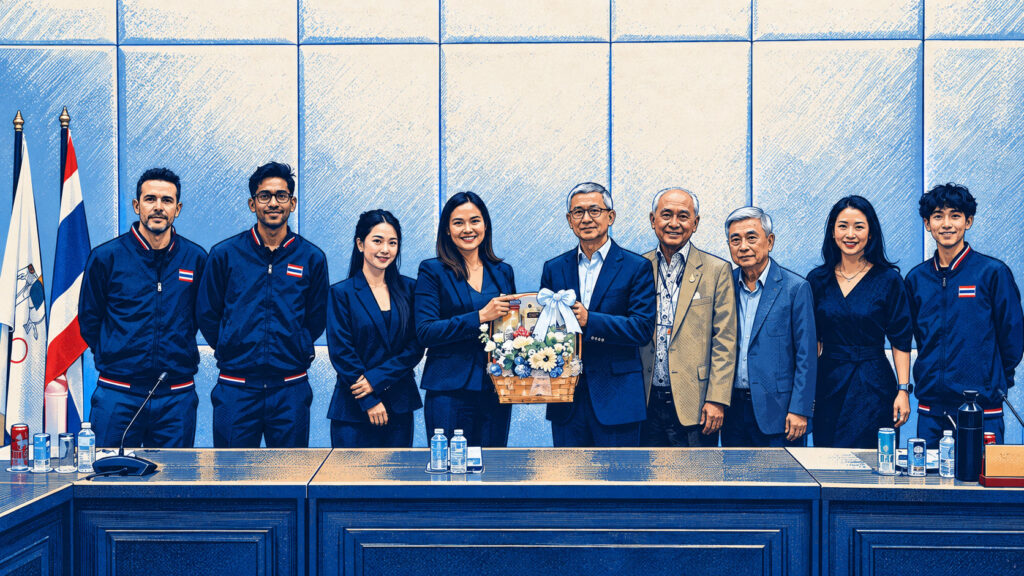
Thai media reports published in July described the Thailand Padel Association taking responsibility for substantial costs of the country’s 2026 Asian Games padel campaign. TV5HD reported an initial budget above THB 600,000, while DailyNews later reported that Grand Sport would supply athlete clothing. The accounts place the association and a commercial supporter around the sporting preparations for Aichi-Nagoya.
The reports also said the association’s registration or recognition process with the Sports Authority of Thailand remained pending at that time. TV5HD’s account appeared on 2 July and DailyNews reported on 26 July. Those dates are part of the information: they describe the position reported during the preparation period, rather than establishing an unchanged administrative status at every later point.
Several kinds of support
A national-team campaign brings together different expenses and different forms of assistance. Travel, accommodation and preparation all contribute to the practical ability of a delegation to compete. Clothing support provides another element. Understanding who supplies each part gives a clearer picture than applying a single broad label to the whole campaign.
The July accounts attributed the competition-cost arrangements to the association and identified Grand Sport’s contribution as clothing. That does not, by itself, establish how every expense was divided or whether individual athletes made contributions. The reported initial budget is also a planning figure, distinct from a final account of what was spent.
For the selected players, the practical importance is straightforward. Reliable arrangements allow them to organise preparation and travel around a defined competition. A small delegation still has to arrive with the equipment, support and time it needs to compete effectively. Those conditions form part of the environment in which sporting performance becomes possible.
Sporting affiliation and domestic administration
The Thailand Padel Association is listed by FIP as an affiliated federation, with membership dating from 2019. International federation affiliation and a domestic administrative process serve different purposes. The July reports about SAT registration should therefore be read as describing that domestic process, alongside the association’s existing international sporting relationship.
Similarly, support for participation at the Asian Games and eligibility for a particular source of funding are separate matters. A team can have a sporting objective and people working to make its participation possible while the details of financial support are being arranged through different channels.
That distinction helps keep the discussion focused on the athletes’ campaign. The relevant practical questions concern the support available for preparation and competition, the responsibilities accepted by the organisations involved and the arrangements that allow the selected delegation to take part.
Four athletes preparing for a new stage
July reporting named Arnav Rawal and Stefano Mocciola for the men’s competition and Natalie Narkprasert and Dares Srirungreang for the women. The published Asian Games programme contains men’s doubles and women’s doubles, giving the announced squad two partnerships to prepare for the continental event.
That is a compact sporting project, but it still requires coordinated work. A pair needs opportunities to train together, test its game in matches and organise recovery around its commitments. The people managing the delegation have a different responsibility: make the practical programme fit the event’s requirements and the support available.
The wider Games are scheduled for 19 September to 4 October, with FIP listing the padel tournament from 28 September to 3 October. The competition dates give the preparation period a clear endpoint and make the timing of support relevant. Arrangements are most useful when they give athletes enough certainty to plan ahead.
Why the funding story matters
For a developing national padel programme, a major event can become a test of how sporting and organisational work connect. Successful preparation depends on more than enthusiasm. It requires people to take responsibility for the resources and decisions surrounding the team, while coaches and athletes concentrate on performance.
The July reports offer a specific account of that work: an association-backed budget, a pending domestic process as reported at the time and clothing assistance from Grand Sport. They provide a dated picture of how Thailand was preparing to enter the padel competition.
The athletes will ultimately be assessed through their matches in Aichi-Nagoya. The support around them matters because it helps create the conditions for those performances. Recognising the different contributions makes the campaign easier to understand and gives each part of the preparation its proper place.
Reader comments
Share your view. Your email address will not be published.
Leave a Reply